If play is costing peace of mind, stopping is the right move
You do not need to wait for a crisis or prove you have a “problem”. If betting is affecting money, sleep, work, relationships or mood, create distance now and involve someone you trust.
Informational destination only. No account is created on this site.
247
VERIFY DOMAIN
PROTECT ACCESS
Do these five things today
Stop access.Close open sessions, remove saved payment methods, uninstall apps and block the relevant sites on your devices.
Protect essential money.Separate rent, food, debt and household funds. Ask a trusted person to help add friction to transfers if needed.
Do not chase losses.Another wager cannot make an earlier loss safer. Treat the loss as finished.
Tell one person.Secrecy increases pressure. Share what happened and what practical help you need.
Seek professional support.A mental-health professional can help with urges, anxiety, debt stress and related harm.
Signals worth taking seriously
Borrowing or using essential household money
Hiding transactions or time spent
Increasing stakes to feel the same excitement
Trying to win back losses quickly
Feeling restless, low or angry when stopping
Missing work, study, sleep or family commitments
Stopping is not losing. It is a decision to prevent the next loss and protect what still matters.
SOS
Immediate danger
If you may harm yourself or someone else, contact local emergency services now or go to the nearest emergency department. Do not stay alone with the crisis; tell a trusted person immediately.
Make the environment support the decision
Willpower is easier when access is inconvenient. Remove bookmarks, unsubscribe from tip channels, mute promotional messages, turn off app-install permissions and ask a trusted person to sit with you while you close access routes. Avoid keeping a separate balance “for one last attempt”; that preserves the cycle rather than ending it.
Urges often rise and fall. Delay any action for at least thirty minutes, leave the room where you usually play, and do something incompatible with betting—walk with someone, make a meal, or handle a small practical task. The aim is not to win an argument with the urge; it is to let the peak pass without spending.
Keep recovery practical
Avoid “systems”, tip groups and recovery schemes. Review bank statements without judgement, list urgent obligations, and seek regulated debt or financial counselling where available. Recovery is easier when financial and emotional support happen together.
If debt is involved, prioritise essentials and honest communication over a rapid fix. Do not take a new high-cost loan to replace gambling losses. A slower plan made with a trustworthy adviser is safer than another risky attempt to erase the problem.
A complete working method for responsible gambling and stopping
Direct answer: The useful way to approach this topic is to slow the sequence down: establish the exact task, verify money, time and wellbeing, calculate what could be exposed, and decide a stop rule before responding to an urge to continue, recover losses or hide activity. Stopping is a successful safety decision, not a failure. This page is information; it does not create accounts, authenticate users, receive funds or confirm an operator.
The goal is setting boundaries that still work during excitement, frustration or loss. That requires more than recognising the Laser247 name. It requires a chain of evidence in which each important claim has an accountable source, each request has a clear purpose, and every personal limit remains effective even when a page or person creates urgency. When an answer cannot be verified, “not established” is more accurate than either trust or accusation.
Use the sections below as a worksheet for responsible gambling and stopping. They organise terminology, actions, decision signals, mistakes and realistic situations around one practical rule: Stopping is a successful safety decision, not a failure. They do not promise availability, legality, safety, winnings, withdrawals or operator conduct; such claims require current evidence independent of an urge to continue, recover losses or hide activity.
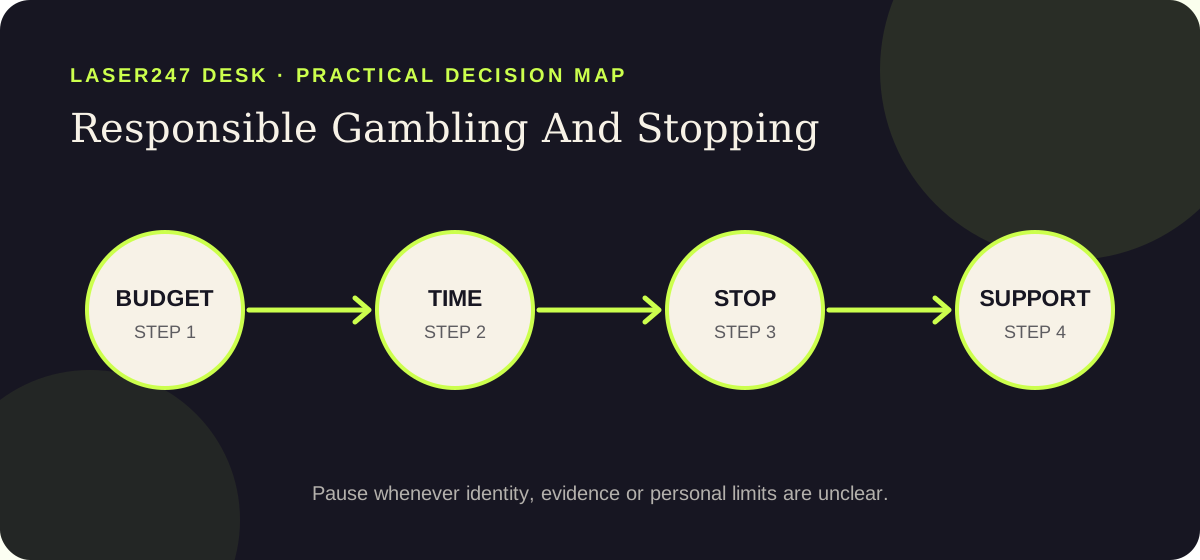
Laser247 Desk decision map: move from evidence to limits and stop whenever a material check remains unresolved.
Terminology
Words that matter when assessing responsible gambling and stopping
In a responsible gambling and stopping decision, familiar terms may carry a precise security, legal or financial meaning. These conservative definitions help a reader evaluate money, time and wellbeing without allowing a promotional phrase or an urge to continue, recover losses or hide activity to stand in for evidence.
Affordable limit
An amount whose loss would not affect essentials, debt payments, savings or another person. In this responsible gambling and stopping context, use the term precisely: ask who supplies the information, what can be checked, and what consequence follows if the assumption is wrong. Clear vocabulary keeps a persuasive label from doing the work of evidence.
Time limit
A firm end point that includes breaks and does not expand because a session is going badly. In this responsible gambling and stopping context, use the term precisely: ask who supplies the information, what can be checked, and what consequence follows if the assumption is wrong. Clear vocabulary keeps a persuasive label from doing the work of evidence.
Chasing losses
Continuing or increasing stakes in an attempt to recover earlier losses quickly. In this responsible gambling and stopping context, use the term precisely: ask who supplies the information, what can be checked, and what consequence follows if the assumption is wrong. Clear vocabulary keeps a persuasive label from doing the work of evidence.
Cooling-off period
Planned time away that interrupts urgency and allows a decision to be reconsidered. In this responsible gambling and stopping context, use the term precisely: ask who supplies the information, what can be checked, and what consequence follows if the assumption is wrong. Clear vocabulary keeps a persuasive label from doing the work of evidence.
Self-exclusion
A formal tool intended to block or restrict access for a selected period. In this responsible gambling and stopping context, use the term precisely: ask who supplies the information, what can be checked, and what consequence follows if the assumption is wrong. Clear vocabulary keeps a persuasive label from doing the work of evidence.
Step by step
Five ordered checks for responsible gambling and stopping
The order supports the goal of setting boundaries that still work during excitement, frustration or loss. Starting with an urge to continue, recover losses or hide activity lets another party control the route; starting with the task, source and limits keeps this responsible gambling and stopping decision reversible until the important questions are answered.
Set the money limit at rest
Choose an amount before exposure to excitement or loss, and treat it as entirely expendable. Never use rent, debt, emergency or borrowed money. For this responsible gambling and stopping check, record what you inspected and which source supported it. If the answer depends only on an urge to continue, recover losses or hide activity, mark it unresolved instead of filling the gap with confidence.
Set an end time
Use an external alarm and include breaks. The end time does not move because a match, market or recovery attempt is unfinished. For this responsible gambling and stopping check, record what you inspected and which source supported it. If the answer depends only on an urge to continue, recover losses or hide activity, mark it unresolved instead of filling the gap with confidence.
Name emotional stop signs
Irritation, secrecy, rapid deposits and an urge to win money back are reasons to stop. The plan should respond to behaviour, not only to balance. For this responsible gambling and stopping check, record what you inspected and which source supported it. If the answer depends only on an urge to continue, recover losses or hide activity, mark it unresolved instead of filling the gap with confidence.
Add friction
Remove saved payment methods, mute promotions and use blocking or exclusion tools. Useful friction creates time between impulse and action. For this responsible gambling and stopping check, record what you inspected and which source supported it. If the answer depends only on an urge to continue, recover losses or hide activity, mark it unresolved instead of filling the gap with confidence.
Choose support in advance
Tell a trusted person what the boundaries are and where help will come from. Support is easier to use when contact details are selected before a crisis. For this responsible gambling and stopping check, record what you inspected and which source supported it. If the answer depends only on an urge to continue, recover losses or hide activity, mark it unresolved instead of filling the gap with confidence.
Decision table
Turn responsible gambling and stopping signals into specific responses
A signal matters when it changes behaviour. For responsible gambling and stopping, the table avoids unsupported “safe” or “unsafe” labels and instead connects each observation about money, time and wellbeing to a proportionate next action.
Signal
Why it matters
Safer response
Chasing
A loss creates urgency to recover rather than reassess.
Stop immediately and do not increase amount or speed. For responsible gambling and stopping, keep the next action proportionate to the possible exposure.
Limit drift
A limit repeatedly expanded during play is not functioning as a limit.
Lock it in advance and add external accountability. For responsible gambling and stopping, keep the next action proportionate to the possible exposure.
Hidden activity
Secrecy can delay support and distort the perceived cost.
Share the concern with a trusted person early. For responsible gambling and stopping, keep the next action proportionate to the possible exposure.
Essential money
Using bills, debt or borrowed funds turns entertainment risk into household harm.
Keep those funds completely outside the activity. For responsible gambling and stopping, keep the next action proportionate to the possible exposure.
Verification notes
Build a concise record for responsible gambling and stopping
Write down the unresolved point
For responsible gambling and stopping, record the exact question before opening another result or message. The working question is whether money, time and wellbeing can support the goal of setting boundaries that still work during excitement, frustration or loss. Note the hostname, date, source and the claim in its original context. This small record prevents a later page from quietly changing the issue and makes “still unknown” a usable conclusion rather than an uncomfortable gap.
Compare conflicts by source quality
When two pages disagree about responsible gambling and stopping, do not count how many repeat each position. Ask which source is accountable, current, independent of an urge to continue, recover losses or hide activity, and directly relevant to the fact being checked. Prefer a narrow supported statement over a broad reassuring one. If neither side meets that standard, retain both links, label the conflict unresolved and avoid any action that would expose credentials, identity, device access or money.
Record why you stopped
A no-action decision protects future choices. Write the stop reason in practical language: the identity was unclear, the terms could not be retained, the legal context needed advice, or the request exceeded the chosen limit. For this responsible gambling and stopping page, use this standing rule: Stopping is a successful safety decision, not a failure. Recording the reason reduces the chance that a later countdown, different contact or newly designed page restarts the same decision without resolving the original problem.
Risks and common mistakes
Where a responsible gambling and stopping decision can lose focus
For responsible gambling and stopping, mistakes often begin with an urge to continue, recover losses or hide activity, a plausible explanation or one small exception—not deliberate recklessness. Naming those patterns before working toward this page’s goal—setting boundaries that still work during excitement, frustration or loss—makes them easier to recognise under pressure.
Chasing
A loss creates urgency to recover rather than reassess. This matters when the practical task is setting boundaries that still work during excitement, frustration or loss. The safer response is simple: stop immediately and do not increase amount or speed. A pause preserves choices; urgency usually removes them.
Limit drift
A limit repeatedly expanded during play is not functioning as a limit. This matters when the practical task is setting boundaries that still work during excitement, frustration or loss. The safer response is simple: lock it in advance and add external accountability. A pause preserves choices; urgency usually removes them.
Hidden activity
Secrecy can delay support and distort the perceived cost. This matters when the practical task is setting boundaries that still work during excitement, frustration or loss. The safer response is simple: share the concern with a trusted person early. A pause preserves choices; urgency usually removes them.
Essential money
Using bills, debt or borrowed funds turns entertainment risk into household harm. This matters when the practical task is setting boundaries that still work during excitement, frustration or loss. The safer response is simple: keep those funds completely outside the activity. A pause preserves choices; urgency usually removes them.
Practical scenarios
Three realistic responsible gambling and stopping situations
These are decision exercises, not claims about Laser247 operations. Each applies the rule “stopping is a successful safety decision, not a failure” while showing how a reader can preserve credentials, money, data or wellbeing without guessing the sender’s motive.
The loss limit is reached
Situation: The session feels recoverable and another event begins soon.
Reasoned response for responsible gambling and stopping: The person stops, logs out and follows the planned cooling-off step rather than renegotiating the limit. The useful result for a Laser247 reader is a controlled process, not a perfect prediction or a decision dictated by one unverified prompt.
Play becomes secretive
Situation: Statements are hidden and questions from family create irritation.
Reasoned response for responsible gambling and stopping: The person recognises secrecy as a stop sign and contacts a trusted person or support service. The useful result for a Laser247 reader is a controlled process, not a perfect prediction or a decision dictated by one unverified prompt.
Borrowing seems temporary
Situation: A short loan appears to offer a way to recover and repay quickly.
Reasoned response for responsible gambling and stopping: The person does not borrow, blocks payment access and seeks financial or behavioural support. The useful result for a Laser247 reader is a controlled process, not a perfect prediction or a decision dictated by one unverified prompt.
Questions and answers
Focused answers about responsible gambling and stopping
What is the first check for responsible gambling and stopping?
State the exact task and expected destination before acting. Then test money, time and wellbeing through a source that is independent of an urge to continue, recover losses or hide activity. This prevents a broad brand search from becoming accidental consent, credential disclosure or payment. This editorial guide cannot make the decision safe by itself; it can only make the unresolved questions visible.
Does a polished Laser247 page prove it is official?
No. For responsible gambling and stopping, design, HTTPS, logos and search position can be useful technical or navigation signals, but none establishes operator identity on its own. Confirm the accountable party and exact hostname outside the page before relying on official-looking presentation. This editorial guide cannot make the decision safe by itself; it can only make the unresolved questions visible.
What should I save while checking?
Keep the exact URL, relevant terms, recipient or publisher details, timestamps and the source used for verification. For responsible gambling and stopping, a contemporaneous record is more reliable than remembering a screen after it changes or disappears. This editorial guide cannot make the decision safe by itself; it can only make the unresolved questions visible.
When is leaving the right decision?
Leave when pressure rises while identity, legality, terms or personal limits remain unclear. Also stop at any request for a password, OTP, UPI PIN, remote-control access or unexplained payment. Stopping is a successful safety decision, not a failure. This editorial guide cannot make the decision safe by itself; it can only make the unresolved questions visible.
Related next steps
Choose the next guide after this responsible gambling and stopping check
Keep the goal of setting boundaries that still work during excitement, frustration or loss separate from later access, registration, payment or legal questions. If the task changes, open the matching guide and begin again with its evidence. Do not carry trust from an urge to continue, recover losses or hide activity into another domain, person or decision without verification.
Hello! 👋 Do you want to Create your IPL Cricket Betting ID ?
Kisi bhi top bookie (Reddy Anna, Lotus, etc.) se apni Betting ID lo, fatak se 60 seconds mein. Tension-free khelo kyunki humara 24/7 live chat support hamesha aapke saath hai.